
Vision standards for driving
Safe driving depends on more than just sharp distance vision. The Ministry of Transportation (MTO) sets minimum standards for visual acuity, side vision, and binocular function, particularly for senior drivers and commercial license holders. Failing to meet these standards — even temporarily — can affect your ability to drive legally.
A complete driving vision exam confirms that your prescription is correct, evaluates your peripheral vision, and identifies any eye health conditions that could affect safe driving. Where appropriate, a prescription update is provided as part of your refractive evaluation.
When you may need a driving vision test
Common reasons to book a driving vision exam include:
- Renewing your driver's license, especially at age 80 and beyond
- Applying for a Class A, B, C, D, E, or F commercial license
- Police academy or first responder vision requirements
- Workplace medical or pre-employment vision forms
- MTO-requested vision report after a medical concern
- Difficulty seeing road signs, lane markings, or pedestrians
- Glare, halos, or trouble driving at night
What happens during your appointment
Dr. Roxanna Gangi begins by reviewing why the test is needed (license renewal, MTO request, employer form, etc.) and any specific paperwork you have brought.
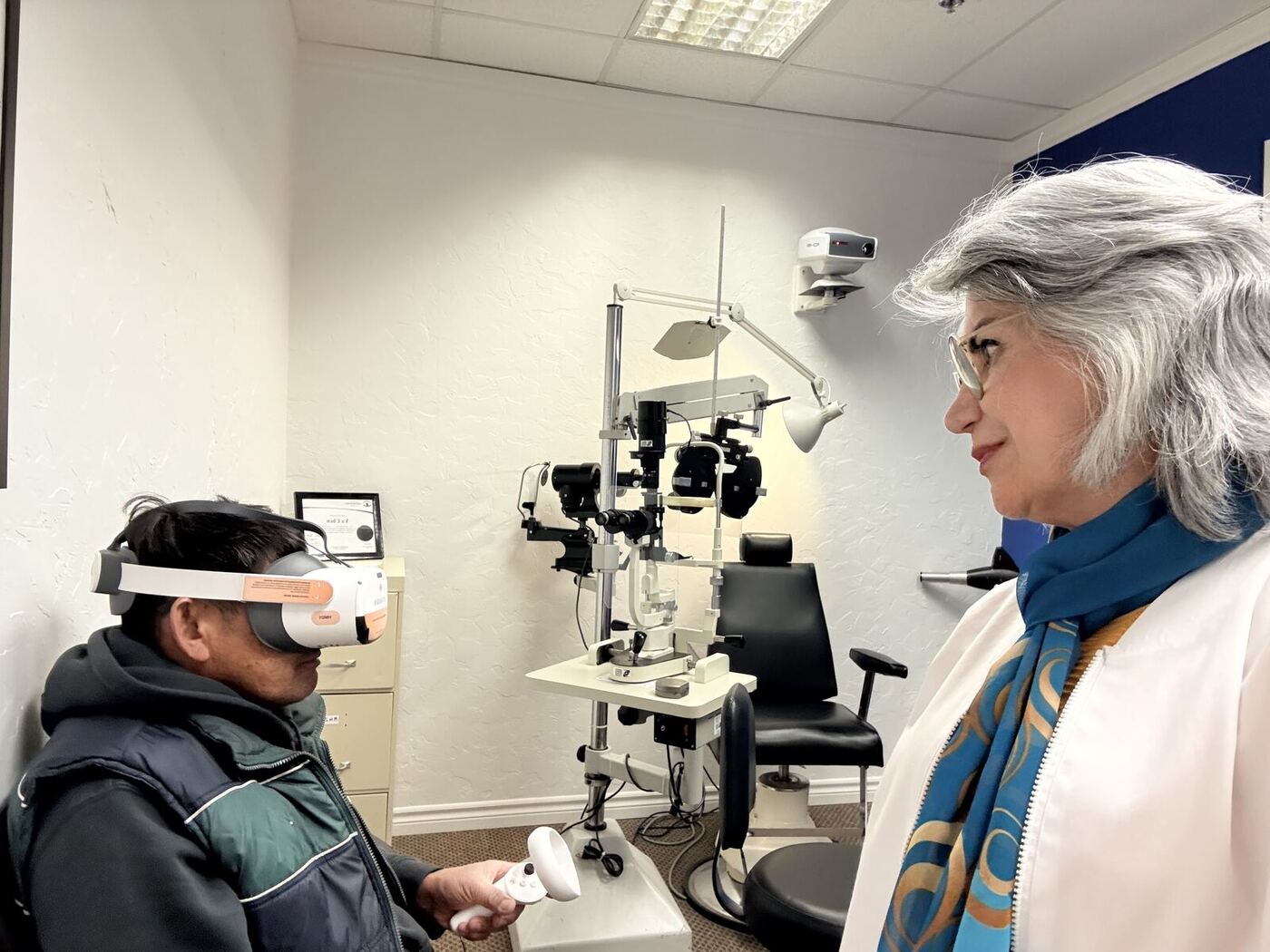
Vision testing checks distance acuity, near vision, eye coordination, and depth perception. If indicated — for example, for senior license renewal, certain commercial licenses, or following an MTO request — visual field testing is performed to confirm your peripheral vision meets the required standard.
Required forms are completed at the appointment whenever possible, and copies are provided for your records. If a prescription update or further care is needed, it is discussed before you leave.

Why drivers choose Dr. Roxanna Gangi
Dr. Roxanna Gangi serves patients across York Region — including Aurora, Newmarket, Richmond Hill, Thornhill, and Vaughan — with personalized, in-person optometry care from Dr. Roxanna Gangi.
Patients value the efficient, accurate process and the experience to handle MTO forms, commercial license requirements, and workplace vision documentation in a single visit.
Related services
Frequently asked questions
Do you complete MTO driver's license vision forms?
Yes. Dr. Roxanna Gangi completes MTO vision reports, including those requiring visual field testing.
Is a driver's license vision exam covered by OHIP?
Vision exams done specifically for licensing or workplace forms are typically not OHIP-covered. Fees are discussed upfront when you book.
How long does the appointment take?
Most driver vision assessments take 20 to 40 minutes, depending on whether visual field testing and additional forms are required.
Do you do visual field testing?
Yes. We perform automated visual field testing in-clinic, which is required for many senior license renewals and commercial endorsements.
Can I get my prescription updated at the same visit?
Yes. If a prescription change is identified during the exam, an updated prescription is provided.
What should I bring?
Bring the form provided by the MTO or your employer, your current glasses or contact lenses, your driver's license, and any previous eye records if available.