Crossed Eyes vs Lazy Eye: Amblyopia in Children Explained
Written or medically reviewed by Dr. Roxanna Gangi, Optometrist
Quick summary
- Lazy eye (amblyopia) is a brain–eye development problem; crossed eyes (strabismus) is an alignment problem.
- Most children with a lazy eye look perfectly normal — their eyes are straight.
- Many pass school vision screenings because the stronger eye compensates.
- Early diagnosis, ideally before age 7, gives the best chance of full visual recovery.
One of the most common things I hear from parents during a children's eye exam is, "My child doesn't have a lazy eye — their eyes look straight." And just as often I hear the opposite: "My child has a lazy eye because one eye turns in."
Both statements come from the same misunderstanding. Lazy eye and crossed eyes are not the same condition, even though they're frequently confused. Understanding the difference is one of the most important things a parent can do to protect their child's vision. I'm Dr. Roxanna Gangi, and across my Aurora, Newmarket, Richmond Hill, Thornhill, and Vaughan clinics, I regularly diagnose amblyopia in children whose parents had no reason to suspect anything was wrong.
What a Lazy Eye Actually Is
A lazy eye — medically called amblyopia — is a condition where one eye doesn't develop normal vision during childhood. The eye itself is usually healthy. The real problem is in the brain.
When a child's brain receives a blurrier or weaker image from one eye, it gradually starts ignoring that input and relies on the stronger eye. Over time, the visual pathway for the weaker eye doesn't fully develop. Because children don't know what "normal" vision is supposed to look like, they almost never complain — which is exactly why this slips past so many families.
Lazy Eye vs Crossed Eyes: The Real Difference
Crossed eyes (strabismus) is a misalignment — one eye drifts inward, outward, up, or down while the other looks straight ahead. Unlike amblyopia, strabismus is usually visible.
| Lazy eye (amblyopia) | Crossed eyes (strabismus) | |
|---|---|---|
| What it is | Vision in one eye didn't develop properly | The eyes don't line up together |
| Can you see it? | Usually no — eyes look normal | Usually yes — one eye visibly turns |
| Where the problem is | Brain–eye connection | Eye muscle / alignment control |
| Relationship | Strabismus can cause amblyopia, but most amblyopia has nothing to do with eye turn | Doesn't always lead to amblyopia, especially if treated early |
So yes — a child can have one, the other, both, or neither. They're connected conditions, but they are not interchangeable.
Why Amblyopia Is So Easy to Miss
Imagine one of your child's eyes sees 20/20 and the other sees 20/80. The stronger eye does almost all the work. Your child reads, plays, watches TV, and keeps up at school — and the weaker eye quietly falls behind. Nothing looks wrong from the outside.
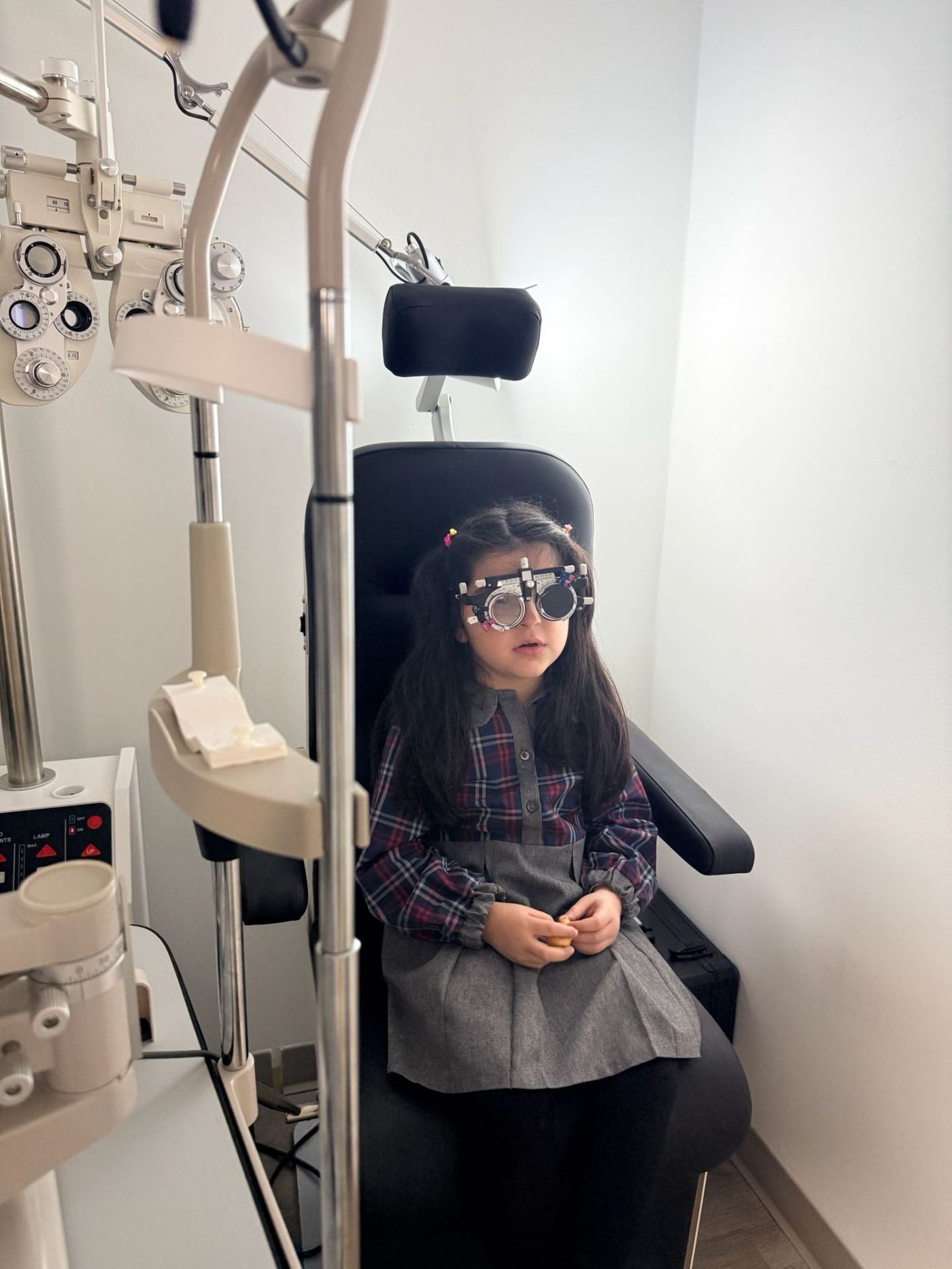
This is why a proper comprehensive eye examination matters so much for kids. Each eye is tested individually, depth perception and eye teaming are assessed, and the prescription is measured objectively — not guessed at from a wall chart.
Four Myths That Cost Children Treatment Time
Myth 1 — "If they can see, their vision is fine." A child can have significant vision loss in one eye and still appear to see perfectly because the stronger eye compensates. The only way to know is to test each eye on its own.
Myth 2 — "The school vision screening would have caught it." School screenings are useful, but they're not a substitute for a full eye exam. Many children with amblyopia pass them because screenings don't fully assess focusing, binocular vision, or subtle differences between the two eyes. I wrote more on this in school vision screening vs a children's eye exam.
Myth 3 — "They'll outgrow it." Amblyopia doesn't typically improve on its own. The visual system has critical windows during childhood, and waiting often means a poorer final outcome. Vision and learning are deeply linked at this age — something I explored in how children's vision affects learning and school success.
Myth 4 — "It's only a cosmetic issue." Amblyopia affects depth perception, reading endurance, sports, hand–eye coordination, and confidence — not just appearance. Severe untreated cases can leave permanent vision loss in the weaker eye.
Signs Worth Watching For
Many children have no obvious symptoms at all. But these are the patterns that should prompt an exam sooner rather than later:
- One eye drifting inward, outward, up, or down
- Frequent squinting or head tilting to see clearly
- Closing or covering one eye while reading
- Difficulty catching a ball or judging distance
- Losing their place while reading or skipping lines
- Avoiding close-up tasks like puzzles, colouring, or homework
- Complaints of blurry vision in only one eye
If reading and tracking are a struggle, our free at-home eye tracking exercise is a quick way to see how smoothly your child's eyes move together. It's not a diagnostic tool, but it's a useful prompt to book an exam if something feels off.
How Amblyopia Is Treated
The encouraging news: when caught early, most cases of amblyopia respond well to treatment. The exact plan depends on the cause.
- Glasses — often the single biggest change. A clear image in both eyes lets the brain start trusting the weaker eye again.
- Patching — covering the stronger eye for set periods each day forces the brain to use the weaker one.
- Vision therapy — structured exercises that rebuild focusing, tracking, and binocular coordination.
- Treating the underlying cause — for example, addressing a significant eye turn, a congenital cataract, or a large prescription difference between the two eyes.
Why Timing Matters
The first several years of life are when the visual system is being wired. Earlier diagnosis means more of that window is still open. By the time a child is clearly struggling in the classroom, valuable treatment time has often already been lost — which is why I encourage families not to wait for symptoms before booking.
When to book
First exam between 6 and 9 months, again around age 3, before kindergarten, and yearly through the school years — even when your child has no complaints and their eyes look perfectly straight.
How We Help Families Across York Region
At our practices in Aurora, Newmarket, Richmond Hill, Thornhill, and Vaughan, our children's and family eye care appointments are built around how kids actually behave in the chair — patient, age-appropriate, and thorough. If amblyopia is found, we'll walk you through every option and put a clear plan in place together.
The Bottom Line
A lazy eye is a developmental issue. Crossed eyes are an alignment issue. Some children have both, many have only one — and most kids with amblyopia look like there's absolutely nothing wrong. That's exactly why a real eye exam, not just a glance at a wall chart, is the best protection a parent can give.
If you have questions about your child's vision or want to rule out amblyopia, book an appointment with me and we'll take a proper look together.
Ready to book your eye exam?
Book an appointment with Dr. Roxanna Gangi today at the Toronto and York Region location most convenient for you.
Book an Appointment